I'm a PhD student and doing a lot of cool stuff, so why not write about it? The first topic that I'm going to document is Documenting your Research and Readings and I'll keep you, the reader, updated on my journey as I flesh out this system.
Essentially, I'm about to transition from a research technician to a full fledged PhD Candidate/actual researcher with the end of a major data collection project, and I think that documenting this process will be useful. I'll release templates and demos as I progress!
Here's a great piece on using databases that partially inspired me.
So far, I've added in a lot of places that should be a central repository for all of my work. Here's a snapshot of what the entry process is.


Essentially, I'm about to transition from a research technician to a full fledged PhD Candidate/actual researcher with the end of a major data collection project, and I think that documenting this process will be useful. I'll release templates and demos as I progress!
Here's a great piece on using databases that partially inspired me.
The Issue
Well, I read a lot of research papers and there is a great need to actually document what I'm doing. Now a off the shelf application like Zotero is good, but I need something more bespoke than that.
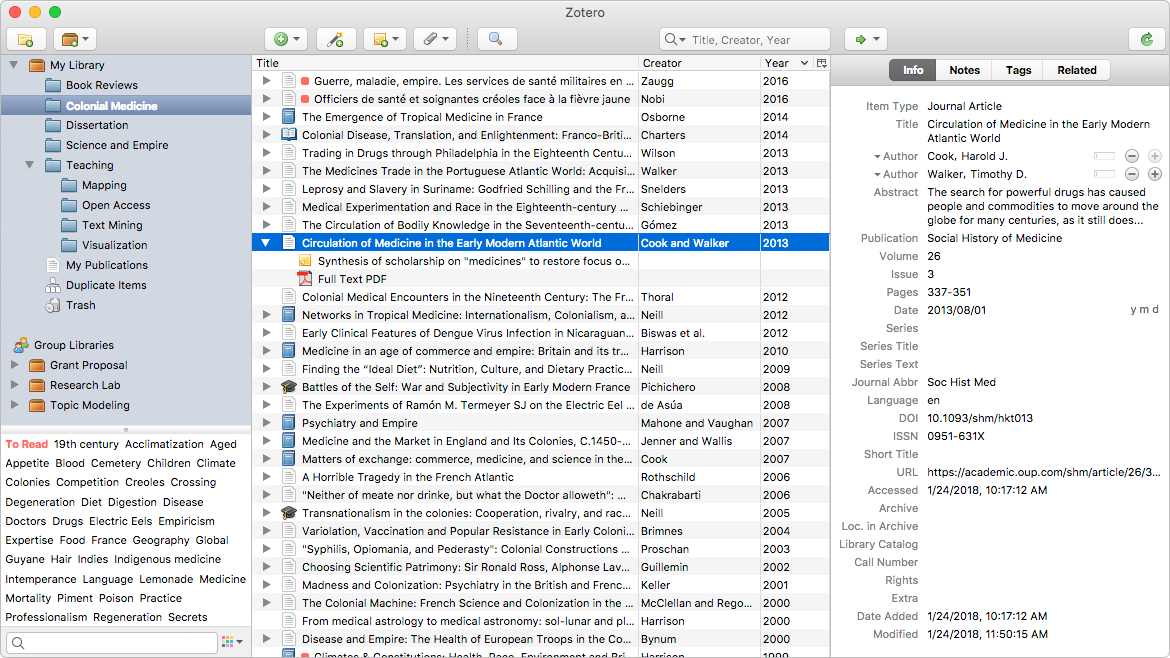 |
| Image from www.zotero.com |
On top of that, I don't have all that coin to keep that paid for all time, but I do have a cloud storage through my school, free access to MS Access, and a growing interest in Database Management Systems (DBMS) that makes me see everything as a potential database action!
The Need
As any good systems engineer and fledgling database manager, I like to start out with the high level requirements. I need to:
- store information related finding the paper
- store abstracts for quick reviews
- store my own reviews of the papers based on a template
- within a useful subset of papers, be able to store other research items, like technical appendices or code that I wrote to emulate some processes described in the paper
- track common writers and streams
- generate citations (maybe I could port this to some kind of LaTeX?)
- store the actual file?
- for a subset, store really important information about the research described (for my work, I'm looking at complexity in engineering and need to study how things are represented, motivated, etc.
- reuse common citations across multiple papers and conference papers (theres some really important papers and books that I'm going to cite until the END OF LINEAR TIME)
Current Solution
Im going to build my own database. I'm totally going to copy the front page of Zoterro with all those columsn in a core table. I'll have a flag to remove a paper read completely from my useful scope (I could filter those out).
I'll have another table for papers cited by the papers in the core table. It'll reference where it comes from and can have duplicates (I could use some sort of search function) that can eventually relate back to the core list.
For a given paper that I'm writing on a topic, I'm going to totally create a sub table that pulls from the core list of all read papers and provide a simple overview.
Core Table
The core table is going to be where I'm going to store most of the content about the paper and its citation and reviews. I'll use the subtables to store everything else and use the primary auto-generated integer key to relate everything back.
I'm looking over Docear a lot and the included JabRef package to figure out all the things to collect.
 |
| It wasn't the best for me, but DOCEAR might be a good choice for you! |

Source Table
Im going to have a single source table so I can collate across fields and read what I enter and how far I go back.

Next steps:
- Developing the project/paper tables
- Developing the forms and queries to help out with cleaner data entry
- Stream Table? As in a specific stream is captured by the following papers?
- Author table? So I can track the work of a specific few people?
Comments